

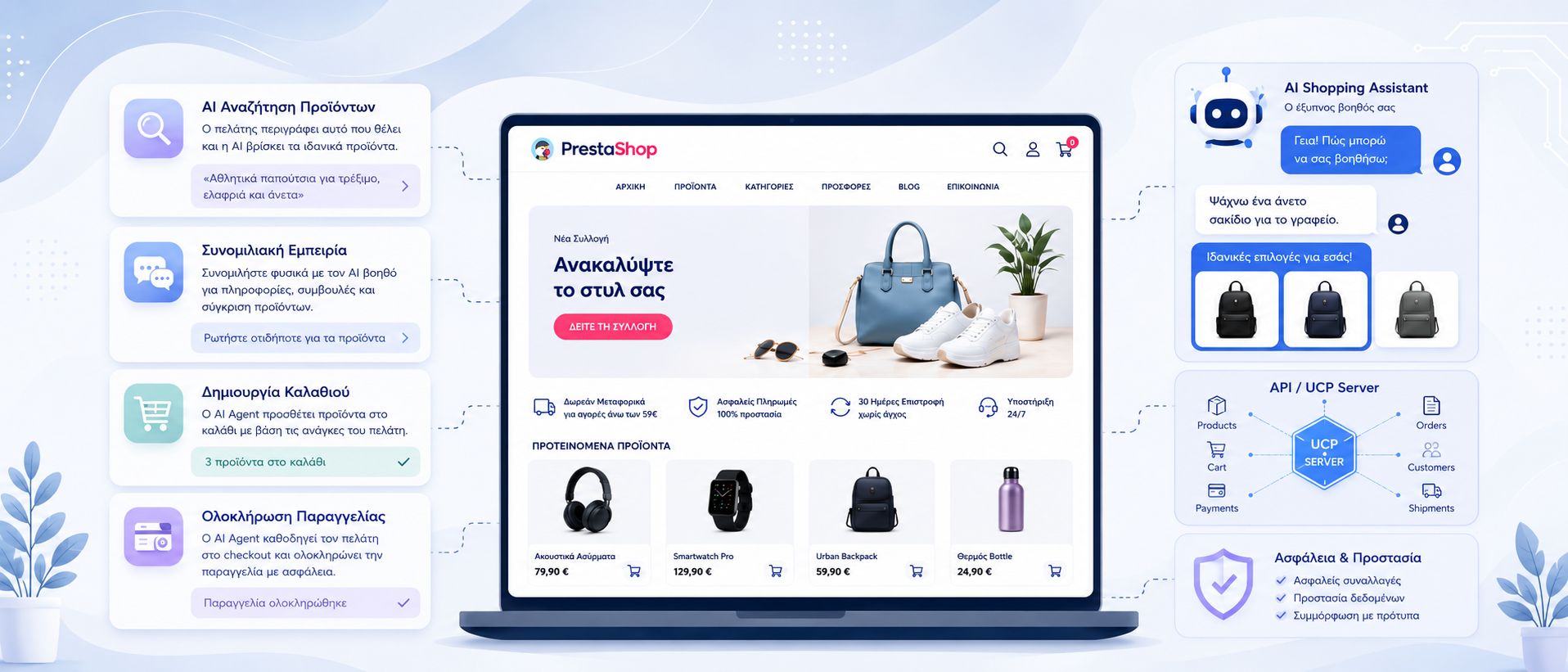
PrestaShop UCP Server: Prepare Your Store for Agentic Commerce
The Universal Commerce Protocol (UCP) is an open standard for agentic commerce: a common way for commerce platforms, businesses, payment providers and AI/agent applications to exchange structured data and support commerce workflows.
For a PrestaShop store, the interesting part is the integration. Products, prices, stock, checkout, shipping and orders already live in PrestaShop. A PrestaShop UCP Server or integration layer can map those real data sources and workflows into UCP-compatible capabilities.
What is UCP?
UCP was created as an open common language for agentic commerce. The current stable specification defines capabilities including checkout, fulfillment, discounts and order lifecycle, together with discovery and payment-handling mechanisms.
UCP does not replace the e-commerce platform. PrestaShop remains the commerce system of record. UCP adds a standardized interface so compatible platforms can discover what the business supports and interact with selected commerce functions.
UCP profiles and capability discovery
A UCP-compatible business publishes a profile declaring the services, capabilities and payment handlers it supports. A compatible platform can then discover those capabilities instead of guessing how checkout or other operations work.
In a PrestaShop implementation, the integration layer needs to map the store's actual capabilities to the UCP profile and related schemas.
Product discovery must use real catalog data
An AI shopping agent is only useful if it receives accurate product information. Titles, combinations, prices, stock, images, attributes and availability should come from the real PrestaShop catalog rather than a stale static copy.
If stock or price is driven by an ERP, the UCP integration should follow the correct source of truth and the existing synchronization workflow.
Checkout sessions
UCP supports standardized checkout flows. For a PrestaShop store, the integration needs to translate line items, quantities, totals, currency and checkout state between the UCP layer and PrestaShop's real cart/order logic.
This does not mean bypassing store rules. Cart rules, taxes, carriers, restrictions and product combinations still need to be calculated by the appropriate business logic.
Fulfillment and shipping
Shipping is rarely a single fixed price. A PrestaShop store may use carriers, zones, weights, thresholds, smart lockers or custom courier integrations.
The UCP layer needs to expose the fulfillment options actually available for the current checkout while keeping the PrestaShop workflow as the source of truth.
Discounts and cart rules
UCP includes a discount capability. In PrestaShop, that should map correctly to cart rules, vouchers and eligibility conditions instead of calculating discounts independently from the store.
Orders and lifecycle
The commerce flow continues after checkout. Order state, shipment, delivery and return information may need to be communicated through compatible UCP mechanisms.
Where an ERP or courier integration exists, we design the flow so PrestaShop, UCP and external systems do not end up with conflicting order state.
Payments
UCP defines payment-handler mechanisms, but payment implementation still depends on the real PSP, security requirements and the capabilities of the platform participating in checkout.
Adding UCP does not automatically make Apple Pay, Google Pay, Stripe or any other payment method available. Payment methods depend on the specific integration and payment provider.
Handoff to the normal PrestaShop checkout
In many scenarios, an agent can help with discovery and cart preparation and then hand the customer off to the normal e-commerce checkout.
A secure handoff can preserve purchase context without requiring every payment or local-commerce function to be implemented directly inside the agent platform.
UCP, MCP and AI agents are not the same thing
MCP is a general protocol for connecting AI applications to tools and data. UCP is a commerce-specific standard for interoperable commerce flows. They can coexist, but they solve different problems.
A PrestaShop project can use MCP for internal/admin AI tools and UCP for customer-facing agentic-commerce interoperability.
Security, authentication and data minimization
Exposing commerce endpoints to external agent platforms requires careful access design. Public catalog data, authenticated checkout state and personal/order data should not be treated the same way.
Authentication, authorization, input validation, rate limiting, logging and data minimization should be designed per capability and per real business use case.
What does “AI-ready store” mean in practice?
It does not mean that publishing one schema file suddenly makes every AI assistant able to sell your products. It means the business has a structured, secure and standards-compatible commerce interface that can be used by platforms supporting UCP.
Product-data quality, checkout rules and integrations remain critical.
Custom PrestaShop UCP development
We can build a UCP integration for PrestaShop that reflects the actual store: combinations, stock, ERP data, pricing, cart rules, shipping, custom modules and order workflow.
This can be implemented as a specialized PrestaShop module or as a separate integration service depending on the architecture.
Prepare for agentic commerce without marketing exaggeration
Agentic commerce is evolving quickly and UCP is a real technical foundation for that direction. There is still no reason to promise that implementation will automatically create sales or rankings.
The value is that a PrestaShop store can gain a standards-based, maintainable interface for new commerce channels without rebuilding the entire e-commerce system.
If you want to evaluate UCP for your PrestaShop store, we can begin with the catalog, checkout, payment and fulfillment workflow and implement only the capabilities that provide practical business value.
UCP is actively evolving. Implementations should target an appropriate stable specification version and be maintained as capabilities and schemas change.